Health & Safety Policy — Flat Clearance Bow
Purpose: This policy sets out the commitments and procedures that govern safe working for our flat clearance and rubbish removal services. Flat Clearance Bow is dedicated to protecting employees, contractors, clients and members of the public from harm arising from waste clearance, house clearance and general rubbish collection operations. The policy complements statutory duties and outlines practical expectations for every team member, contractor and site visitor involved in clearance work.Scope and Principles
Our approach covers all aspects of waste handling and property clearance activities, including bulk rubbish removal, furniture removal from flats, and responsible disposal of household waste. The principles are hazard identification, risk management, safe systems of work, and continuous improvement. We require compliance with company procedures, use of appropriate protective equipment and adherence to safe vehicle loading and manual handling practices. Safety is integral to service delivery and operational planning for every job.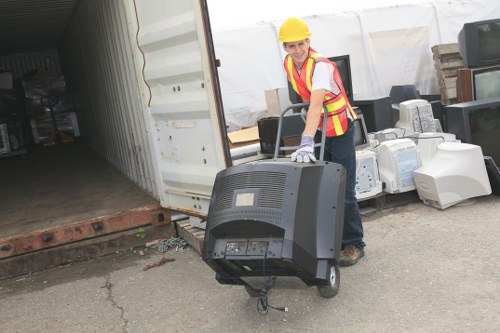
- Who the policy applies to: employees, agency staff and subcontractors engaged in clearance or rubbish collection tasks.
- Where it applies: at client properties, during transit, at transfer stations and within any premises where waste is handled.
- What it covers: manual handling, hazardous materials, sharps and contaminated items, vehicle safety, PPE, slips/trips/falls, and incident reporting.
Responsibilities
Management will ensure that suitable arrangements are in place, including resourcing, training and monitoring, to implement this policy. Supervisors and team leaders must ensure safe working methods are planned and communicated before clearance work begins. Employees and operatives are required to follow safety instructions, wear issued protective clothing and report hazards, unsafe acts or near misses promptly. Non-compliance with mandatory safety procedures will be addressed through corrective action and, where necessary, disciplinary measures.
Risk Assessment & Safe Work Methods
Every clearance job must be preceded by an assessment of foreseeable risks. Risk assessments will identify hazards such as heavy lifting, awkward access, biological contamination, asbestos risk signs, electrical hazards and traffic movement. Control measures include mechanical aids, two-person lifts, clearly defined exclusion zones, and safe segregation of recyclable and hazardous waste. Safe systems of work are recorded and made available to operatives prior to task commencement.Training & Competence: All staff receive induction training relevant to waste removal duties and periodic refresher training. Competence assessments cover manual handling techniques, use of lifting equipment, safe operation of compactors and handling of sharps or hazardous household chemicals. Contractors must demonstrate equivalent training and safety standards before engagement and must cooperate with on-site safety controls.
PPE, Equipment and Vehicle Safety
Appropriate personal protective equipment (PPE) is provided and must be worn at all times when required: hi-visibility clothing, gloves, safety footwear and eye protection. Equipment such as trolleys, lifting straps and tail-lift vehicles are inspected before use; any defect must be reported and the equipment withdrawn from service. Vehicle safety includes secure load restraint, regular maintenance, safe reversing procedures and fatigue management for drivers engaged in rubbish collection and home clearance runs.
Handling Hazardous and Contaminated Waste
Some clearances may reveal hazardous materials or contaminated waste. These items are to be segregated, labelled and handled in line with legal obligations and best practice. Operatives must not attempt to remove items suspected of containing asbestos, unknown chemicals, or biological hazards without specialist assessment and control. The company will arrange for qualified contractors to deal with hazardous waste requiring specialized removal.
Incident Reporting, Monitoring and Review
All incidents, injuries, near misses and property damage must be reported immediately using the company incident system. Reports will be investigated to identify root causes and to develop preventive measures. Management will monitor safety performance through regular site checks, toolbox talks and audits. This policy will be reviewed annually or following significant incidents, changes in legislation or operational practice, ensuring continual improvement in our rubbish clearance and waste removal services.Statement of commitment: We are committed to ensuring that our house clearance, flat clearance and rubbish removal operations are conducted in accordance with this Health & Safety Policy. Everyone engaged in our operations has a duty to take reasonable care for their own safety and that of others. Through diligent risk management, clear responsibilities, appropriate training and ongoing review, Flat Clearance Bow aims to deliver safe and responsible clearance services.